
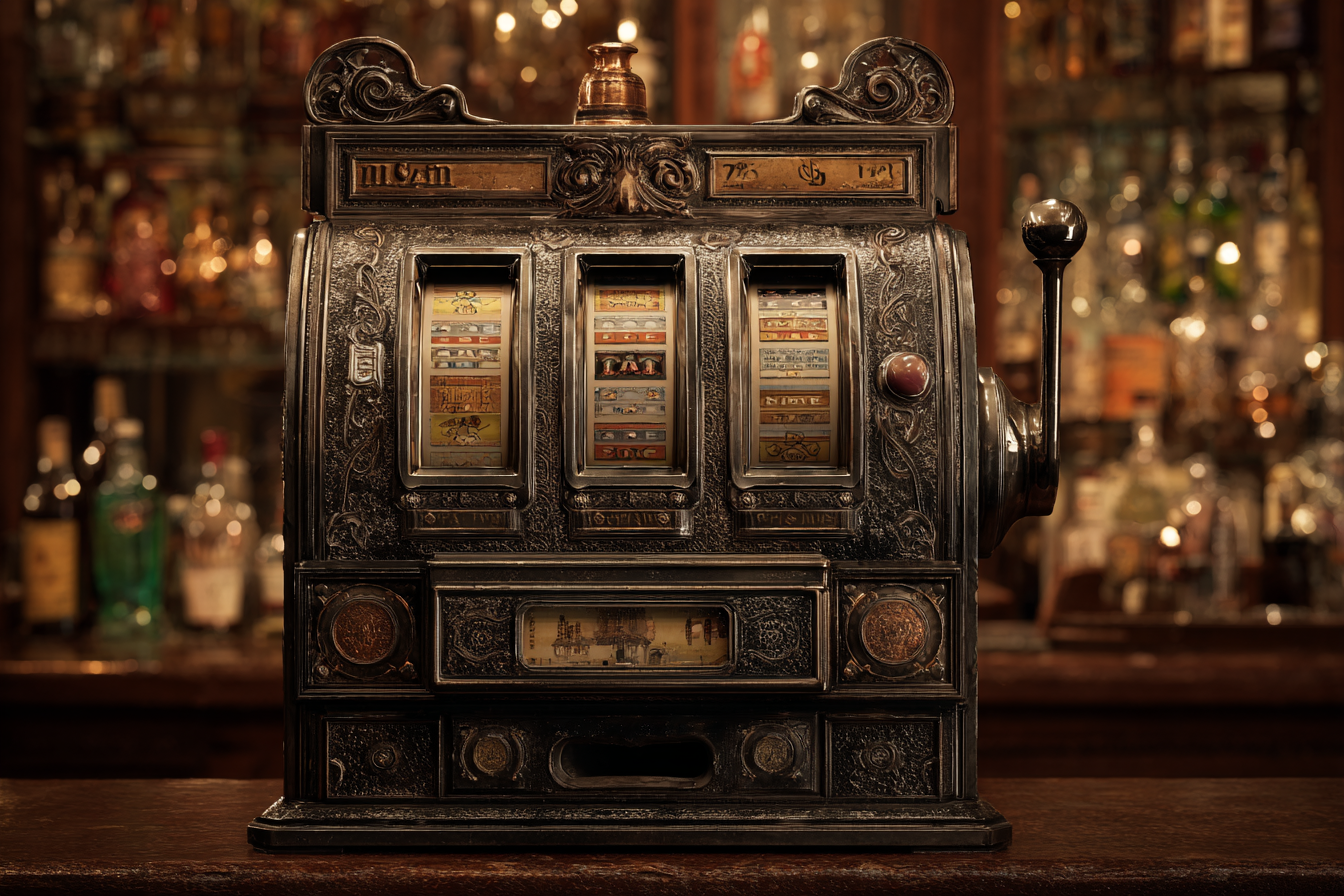
Slot machines now generate more casino floor revenue than all table games combined, and it all started with one Bavarian immigrant working out of a San Francisco workshop in the 1890s. The story of how a mechanical nickel machine became a global digital industry is one of the more unlikely arcs in entertainment history.
The Man Who Built the First Slot Machine
Charles Fey, a Bavarian immigrant who worked as a San Francisco machinist, built the Liberty Bell in the 1890s. The machine was built around a simple mechanic: deposit a nickel, pull the side lever, watch three reels spin. The reels carried five symbols: diamonds, spades, horseshoes, hearts, and the Liberty Bell. Lining up three Liberty Bells paid the top prize of 50 cents, or ten nickels.
By modern standards, that sounds modest, but the machine was a genuine engineering achievement. Because only three symbols of the thousand possible combinations were visible with any given spin, players could not calculate the payout percentage the way they could on older color-wheel machines, and three reels created far more suspenseful near-miss moments than earlier single-stop devices.
Fruit Symbols, BAR Icons, and the Gum Machine Workaround
Fruit symbols still common on slots today did not start as mere decoration. In the early 1900s, as cities like San Francisco banned coin‑payout slot machines, manufacturers such as Mills Novelty reworked machines to dispense fruit-flavored gum instead of cash. The reels were adorned with fruit images to match the gum flavors, turning them into quasi‑vending devices.
The BAR symbol, later associated with these fruit‑style machines, likely evolved from a stylized image of a chewing gum packet or gum‑company logo, which hardened into the BAR icon seen on thousands of modern slot titles.
Las Vegas and the Rise of the Modern Casino Slot
Fey’s machines never operated inside casinos during his lifetime. They ran in saloons and bars. It was Bugsy Siegel, opening the Flamingo Hotel Casino in Las Vegas in 1946, who first brought slot machines into a casino environment. Within a few years, revenue from those machines exceeded what the table games were generating. That ratio has only widened since.
The next meaningful technical leap came in 1963. Bally Manufacturing developed the first fully mechanical slot machine that featured a bottomless hopper and could pay out up to 500 coins automatically, without any attendant involvement.
Players still pulled a lever to start the reels, partly because Bally did not want the machine to feel unfamiliar to anyone used to older devices. That lever is where the nickname “one-armed bandit” came from, and it stuck even after buttons replaced handles entirely.
The key milestones in slot machine development between 1898 and the mid-1990s break down like this:
- The Liberty Bell, 1898:Three mechanical reels, five symbols, 50-cent top prize; the template every machine since has followed.
- Operator Bell, 1910:Mills Novelty Company introduced fruit symbols and the gooseneck coin acceptor; over 30,000 units were produced.
- Money Honey, 1963:Electromechanical design unlocked multi-coin bets, larger payouts, lights, and sound.
- First video slot, 1976:Fortune Coin Co. built a machine using a modified Sony Trinitron TV screen in Kearny Mesa, California; it was installed at the Las Vegas Hilton after Nevada gaming regulators approved it in 1978.
- Random number generator patent, 1984:Igne S. Telnaes was awarded US Patent 4,448,419 for an electronic gaming device using an RNG to select reel stop positions, which separated the visual display from the actual outcome determination.
These developments have turned the machines into the games we know now, available in demo mode on review sites like clashofslots and for real-money play in multiple casinos worldwide.
Online Slots and the Shift to Digital
Online slots effectively began in 1994 when Antigua and Barbuda passed the Free Trade and Processing Act, allowing companies worldwide to open online casinos legally. Microgaming was the first to build the software infrastructure. The distribution model, though, was the real shift. Anyone with an internet connection could now play.
The move to mobile followed a predictable pattern. In 2005, Pub Fruity became the first Java casino game released for mobile phones, signaling that slots would eventually be playable anywhere. Developers then spent the next decade optimizing their entire libraries for touchscreens, smaller displays, and variable connection speeds.
What the Modern Slot Library Looks Like
The difference between a 1998 online slot and a current title is roughly the difference between a dial-up modem and fiber broadband. Contemporary releases carry mechanics that did not exist as recently as ten years ago:
- Megaways:A dynamic reel modifier licensed by Big Time Gaming that generates up to 117,649 ways to win per spin, first appearing in 2016.
- Cluster pays:Wins triggered by groups of matching symbols rather than fixed paylines, removing the left-to-right reel structure entirely.
- Cascading reels:Winning symbols disappear after a win and new ones fall into place, allowing consecutive wins from a single spin.
- Buy-a-bonus:Players pay a set multiplier of their stake to enter a bonus round directly, bypassing the base game trigger.
These mechanics are now industry standard, and a player loading a slot from any major developer today has access to tools that would have been unthinkable in a San Francisco saloon in 1898.
AI Enters the Picture
Artificial intelligence is a relatively new player in the online entertainment industry, but already an influential one. It sits behind the scenes, mostly invisible to players, but is reshaping how games are built, recommended, and presented.
How AI Is Used in Slot Gaming Now
According to recent industry reports, 30% of new casino games released to the market now integrate AI to personalize gameplay and adapt difficulty to individual players. That figure is growing year on year.
The applications fall into a few clear categories:
- Game recommendations:Platforms analyze session history and suggest titles based on a player’s demonstrated preferences, volatility tolerance, and theme patterns.
- Dynamic difficulty adjustment:Machine learning models study behavior in real time. If a player consistently switches from slots to a different game after repeated losses, the system learns that pattern and offers alternatives at that moment.
- Fraud detection:AI flags unusual betting patterns and transaction anomalies faster than any human compliance team could manage.
And, of course, AI-powered customer service chatbots now handle over 60% of customer inquiries at online casinos
What Has Not Changed
For all the technology that has accumulated since 1898, the underlying mechanic is the same one Fey built. A player places a wager, initiates a spin, and waits to see what combination lands. The symbols are more elaborate, the bonus rounds are longer, and the mathematics behind the RNG is audited by third-party labs. But the fundamental exchange between stake and outcome has stayed constant since the Liberty Bell first rang in a San Francisco saloon.