
Walk past almost any well-lit commercial building during the holiday season and there’s a good chance the roofline is strung with C9 bulbs. They’re the large, cone-shaped lights that have been a staple of professional and large-scale residential holiday displays for decades. If you’ve been wondering what sets them apart from the other bulb types on the market, or whether they’re the right choice for your own display, here’s a practical breakdown.
What the Name Actually Means
The ‘C’ in C9 stands for cone, describing the bulb’s distinctive tapered shape. The number refers to the bulb’s diameter in eighths of an inch, which means a C9 bulb has a diameter of nine-eighths of an inch, or roughly 1.125 inches. According to lighting specialists at 1000Bulbs, C9 bulbs typically measure around 2.25 inches long, use an E17 intermediate base, and in their incandescent form draw between 7 and 10 watts each. Their LED equivalents draw a fraction of that while delivering noticeably more light output, since LEDs don’t lose the majority of their energy as heat the way incandescent bulbs do.
The size difference between C9s and their smaller counterparts, the C7s, is meaningful in practice. C7 bulbs are shorter and narrower, which makes them well-suited for detailed work: window frames, railings, and applications where tight spacing matters. C9 bulbs are built for situations where you need the display to read from a distance.
Why Visibility Is the Key Variable
The defining characteristic of the C9 is brightness over distance. Creative Displays notes that LED C9 bulbs produce 80 to 120 lumens each, compared to 40 to 80 lumens for C7 LEDs. That output difference translates directly to visual range. A C9 roofline display is designed to be seen from across a car park, a busy road, or the length of a commercial strip. A C7 display is designed to be appreciated up close.
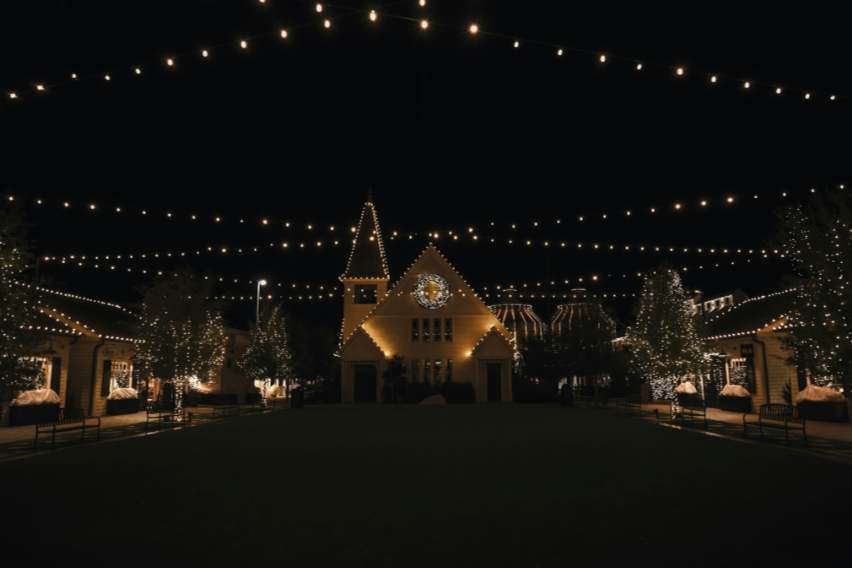
This is why C9 bulbs became the default for commercial and municipal installations. Shopping centers, business districts, churches, and large residential properties all benefit from the C9’s ability to make a statement at distance. Smaller bulbs simply don’t carry enough visual weight to register on a large facade from the street.
Where C9 Lights Work Best
The applications where C9 Christmas lights consistently outperform other formats are rooflines, perimeter outlines on large buildings, strings along fences or long driveways, wrapping wide-trunked trees, and any large-scale outdoor installation where the viewer is more than a few metres away. Professional installers typically pair them with C7s in the same display: C9s handle the primary structural elements and high-visibility runs, while C7s fill in the finer detail work at eye level.
The C9 is a purpose-built outdoor and large-scale bulb, and it performs accordingly when used in those contexts.
Incandescent vs LED: The Practical Decision
For anyone planning a new installation rather than replacing an existing one, LED C9s are the more practical choice by most measures. They draw significantly less power per bulb, which matters considerably when running hundreds of bulbs across a large display over several weeks. Their lower heat output also makes them safer near greenery, timber, and any material that could become a fire risk. LED C9s are also available in a wider color temperature range, from warm white that closely mimics the look of incandescents to crisp cool whites and vivid saturated colors.
The upfront cost of LED C9s is higher than incandescents, but commercial-grade LED strings are rated to last tens of thousands of hours. Maintained and stored properly between seasons, a quality LED C9 installation should serve a property for five or more years, making the per-season cost considerably lower than repeatedly replacing cheaper alternatives.
Spacing and Circuit Planning Before You Start
One practical consideration worth understanding before ordering: C9 strings are typically sold in standard lengths with sockets spaced at set intervals — commonly 12 or 24 inches apart. The spacing you choose affects how many bulbs you need and how the finished display reads. Tighter spacing creates a denser, more continuous line of light; wider spacing is more economical and suits longer runs like fence lines or extended rooflines.
Circuit capacity also deserves attention. Even though LED C9 bulbs draw minimal power individually, a long run of them across multiple strings can add up. Mapping your exterior outlets and understanding the circuit limits before planning your layout prevents both electrical failures and mid-season troubleshooting.
The C9 has been the commercial standard for outdoor Christmas lighting for good reason. When the goal is a display that reads clearly from a distance, holds up through weeks of outdoor exposure, and creates a genuine visual presence in the dark, few formats match what a well-specified C9 string can do.