
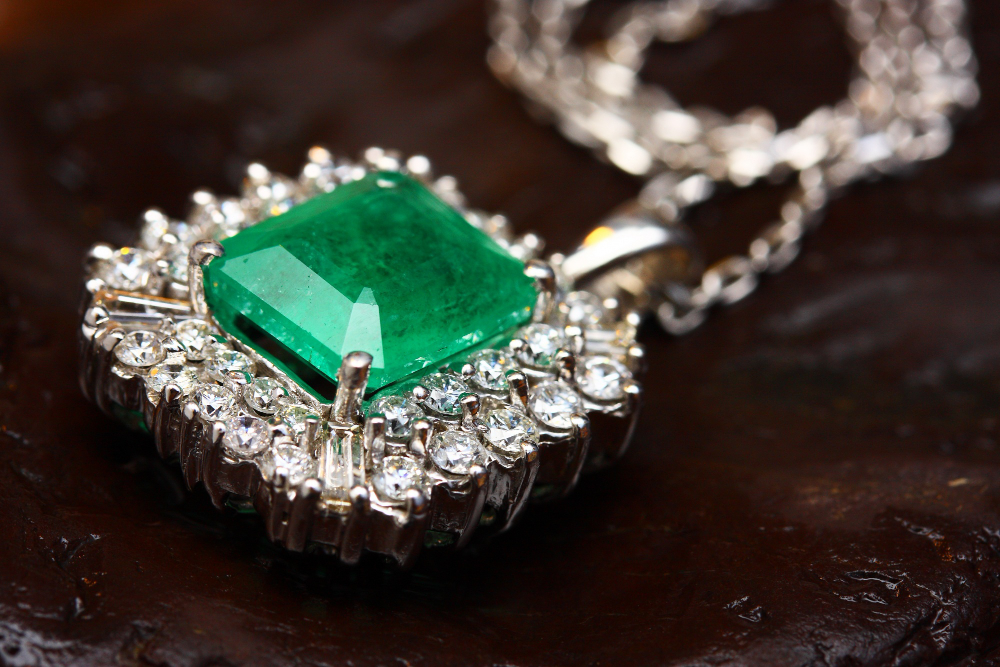
The stone in the photograph looks colourless, yet the description says “emerald cut”. It’s easy to wonder whether you’ve missed something. An emerald-cut diamond is still a diamond: the name describes its outline and the arrangement of its facets, rather than its colour.
It works the other way round, too. An emerald gemstone can be oval or round. Once you separate the stone from the cut, jewellery descriptions become much easier to read, especially when two quite different rings seem to share the same name.
Start with what the stone actually is
GIA describes emerald as the green to bluish green variety of beryl. That is the gemstone. “Emerald cut” names a particular outline and facet pattern, which can be used on different gemstones.
GIA explains that the cut was developed for emeralds, with the aim of easing pressure during cutting and reducing chipping. That’s why the name travels with the cut, even when the stone is a diamond.
Lily Arkwright’s collection of emerald-cut gemstone designs includes the yellow-gold Paris ring. Read its listing in parts: “emerald-cut” is the cut, “lab-grown green emerald” identifies the centre stone and its origin, and “hidden halo” describes the setting. The 18ct yellow gold is the metal.
Keep those details separate when comparing rings. A listing should tell you the centre stone’s identity and origin as well as its cut. A photograph of something green cannot supply that information by itself.
A rectangle is only part of the story
Look closely at an emerald cut and you’ll see cropped corners, rather than four sharp points. Its facets, the flat surfaces cut into the gemstone, run in steps. Those longer lines are part of what gives it such a recognisable appearance.
GIA’s guide to shape and cut style explains why an outline alone isn’t enough. An emerald-cut diamond and a radiant-cut diamond can have similar rectangular outlines, yet their facet arrangements differ. If you’re comparing photographs, look inside the outline as well as around its edge.
You may realise that it was the stepped pattern you liked, rather than rectangular stones generally. Or perhaps the attraction was simply a longer shape across your finger. Ask to compare examples that help you settle that question, with the actual length and width available in millimetres.
The setting has its own name
Then there’s the metalwork holding the gemstone. “Halo”, “solitaire” and “hidden halo” describe aspects of the ring’s design; they don’t identify the centre material or turn it into a different cut.
To find the Paris ring’s hidden halo, look at its side view. The smaller diamonds sit beneath the green centre, so they don’t form a visible border in the overhead view. A conventional halo would instead frame the centre with smaller stones when viewed from above.
This is where scrolling through the whole gallery helps. Notice where the claws meet the corners, how far the ring rises above the band and where any smaller stones sit. You can enjoy the clean rectangle from above and still want something decorative underneath it.
Care follows the gemstone
An emerald-cut diamond and an emerald-cut emerald can share an outline and need different care. GIA’s emerald care guide notes that emerald needs more care in wear than ruby or sapphire. Ask the jeweller about the specific stone, any treatments and the complete setting before taking it home. A shared cut name isn’t a reason to use the same cleaning method.
Say which part you’ve fallen for
A useful description might be: “I like the green, but I want to compare that long rectangle with an oval.” Or: “It’s the stepped shape I love. I haven’t decided on the gemstone yet.” Either gives the jeweller much more to work with than “something emerald”.
You don’t need to memorise a catalogue of terms. Just make sure you know which word names the stone and which describes the cut. Then you can spend the appointment looking at the rings, rather than wondering why an emerald-cut diamond isn’t green.