
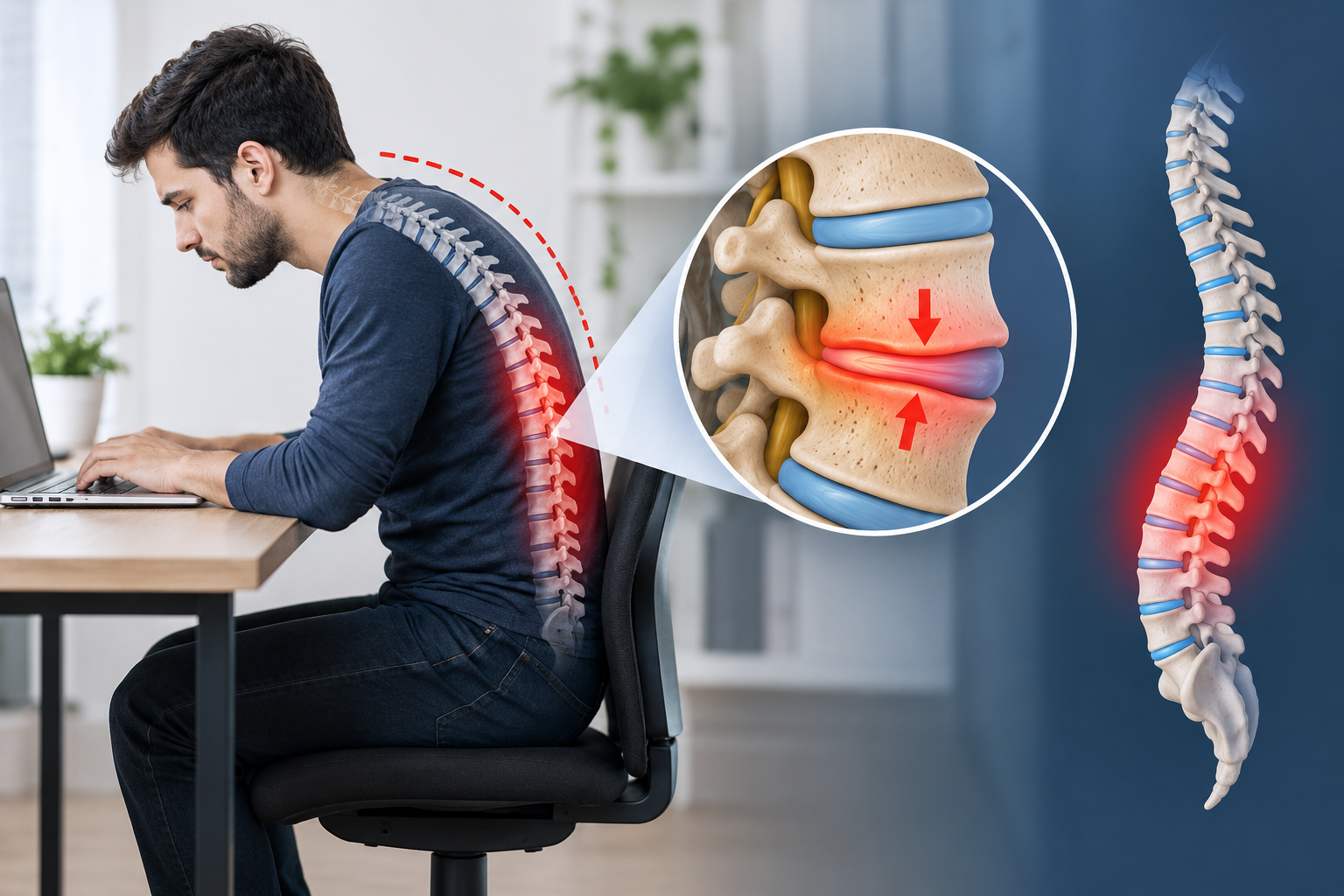
Most people conceive of back discomfort as a muscle condition, you slept badly, lifted something awkwardly or sat too long. Sometimes it is. But there is another layer of tissue in the spine that requires some consideration – the disks between your vertebrae. When these are stressed for a long time the discomfort can be more obstinate and harder to ignore.
The True Purpose of Spinal Disks
Each disk acts as a cushion between the two vertebrae. It features a hard outer shell and a softer gel-like middle. They work together to absorb trauma, enabling the spine to bend and twist and prevent the bones from grinding against one another.
Disks have a poor blood supply and need mobility to keep healthy. They also tend to lose some of their water content with age, which makes them less flexible and more prone to wear..
How posture comes into play
The weight your spine carries is specific to the posture you are in. For instance, sitting in a chair tends to put pressure toward the rear of the disks, particularly in the lower back. You may be holding it for hours a day, month after month, year after year and the outer wall of the disk can slowly disintegrate.
Other daily habits contribute to this: hunching over a laptop, slouching on a sofa, carrying a large bag on one shoulder, or lifting with a curved spine instead of bent knees. None of these dramatic on their own. What counts is the repetition.
Warning signs indicating something may be wrong
Disks that are out of the border can irritate the neighboring nerves. People usually report symptoms such as:
- Lower back or neck ache greater with sitting, bending or coughing
- Pain, tingling or numbness that goes down an arm or leg
- Limb involved is weak
- Stiffness that persists even relaxation
Not everyone with a bulging disk will have symptoms and several other things can create comparable symptoms. That’s why a proper assessment is more important than guessing.”
Prevention begins with daily behaviors
The good news is many of the routines that secure your disks are simple:
- Vary positions often. Even good posture gets tiresome if you keep it too long. Stand, walk or stretch every half hour or so.
- Give your lower back support. A modest cushion or lumbar roll can assist you in sitting with a more natural curvature.
- Lift quickly. Keep the load close to your body, use your hips and knees to raise and don’t twist when you lift.
- Strengthen your back and core. Strong supporting muscles help share the load otherwise placed on your disks.
- Maintain a healthy weight and keep active. “Walking and mild exercise are good for disks.
Getting help with posture itself
If you are regularly experiencing stress in your neck, shoulders or lower back it is worth exploring the reason rather than just the symptoms. A skilled practitioner can examine your sitting, standing and movement to propose exercises, modifications and changes to your workspace, just for you. If stretching and ergonomic fixes aren’t enough, it’s a good idea to seek treatment for poor posture. It’s better to change the pattern early, to cut down on the strain that builds up on the spine over time.
When a disc problem is suspected
If you’re experiencing radiating pain, numbness, or weakness, the guidance goes from basic posture recommendations to a more specific approach. Treatment for a bulging disk is frequently aimed at relieving pressure on inflamed nerves, restoring movement, and strengthening the muscles that support the spine. Many are seeking bulging disc treatment that includes hands-on care, guided exercise and practical instruction rather than rest. What the correct way to go is depends on your diagnosis. But your best bet is to initiate an in-person evaluation.
Provide the recuperation time
Disks and surrounding tissue heal slowly. Often improvement comes in stages: less discomfort first, better movement, then more strength and confidence. The difference in how well the results last has a lot to do with consistency of doing the workouts advised and not doing the things that got you into trouble in the first place.
When to seek immediate medical treatment
Some symptoms can’t wait. Seek medical assistance immediately if you have loss of bladder or bowel control, numbness in your groin or inner thighs, weakness in a leg that gets worse quickly, or severe pain following an accident or fall. They may be signs of a serious condition that demands quick evaluation.
The bottom line
Your spine is designed to move. Your disks need to move. Little daily changes like how you sit, lift and relax can save them for years. If the pain continues coming back or travels beyond your back or neck, get it checked out. Don’t push through. “Usually it is easier and more effective to address early rather than to wait.